Sunday, May 4, 2008

San Juan and Home

The drive to San Juan through the mountains was beautiful but tortuous. High in the rain forest, we found a restaurant perched on a peak with stunning views. We ate lunch, then wound our way down the northern slopes.

We needed to return the car and were trying to decided exactly how to manage everything. Our initial idea was to book a room in a nearby budget hotel, get up at 4 a.m., return the car, then catch the plane. I then suggested that we return the car, stay in the airport hotel, and have a slightly more leisurely morning (if more expensive night). WW agreed. So, we had to return the car.

Easier said than done. We followed the 4-years-out-of-date map Leaseway had given us. We found ourselves mired in darkest San Juanurbia. We asked directions. Things got worse. We asked more directions. Finally, WW took matters into his own hands and just drove where he thought it would be. He has an admirable sense of whereness. He is constantly doing things like this. I am staring at a map that clearly says “go right” and he opts for left and gets there. Very irritating. Needless to say, he found it minutes later. And a lucky thing too. When he told them he’d thought of returning the car next morning, they said they weren’t open at 4 a.m. Phew.

A nice Leaseway man drove us back to the airport where we booked in for the night. The next day we had a reasonably early (6:30 a.m.) start, but it wasn’t any 4 a.m. Thanks be.

Our plane arrived a little bit early in Newark and we saw an earlier flight to Montreal had been delayed. We ran over to the gate and managed to get on. Instead of arriving home at 6 p.m., we were off the plane at 12:30 p.m.

We stayed home until April 30, when we flew back to San Juan.

Tibes, a Stop on the Road

The drive to San Juan from Ponce—really, from just about anywhere to just about anywhere in PR—is a couple of hours. I had very much wanted to visit the Centro Ceremonial Indígena de Tibes. This archeological site is one of the few in the Caribbean which contains evidence of Taíno, Igneris, and other pre-Taíno cultures. We decided to go there, then drive through the central mountains to San Juan.

Nothing in PR seems to be on the beaten track. It was not easy finding Tibes, but when we did, it was immensely worth it. A wonderful small museum, complete with one of the 168 skeletons found buried on the site, and the only one removed. Curled into a fetal position (apparently in expectation of rebirth) and still embedded in the soil, it made a startling and sad exhibit. When we had toured the museum, we were taken to watch a film about the dig. Then we waited for our guide.

Unaccompanied entry into the site is strictly prohibited. Our guide Salvatore Mas eventually appeared; on his shaven head he wore a leather yarmulke. I was dying to ask how he kept it on…but I never had the guts.

We were joined by a young man who spoke fluent Spanish but chose to be in the less crowded inglese group. We later learned he was a Mayan archaeologist, originally from Mexico, studying at Waterloo. Led by Sal, we crossed over a gated bridge and he began the tour by introducing us to a number of native trees that provide all manner of food and useful by-products. One particularly fascinating tree sprouts round gourds out the side of its branches. These the Indians would cut in half, clean out and dry, to make sturdy, lightweight bowls.

A gourd tree at Tibes

In the midst of this botanical exegesis, a horde of puertorriqueños came pouring over the bridge and started wandering about, with no guide at all. Sal became very agitated. “Someone’s going to get in trouble,” he said. He trotted back to the main building to find the group an escort. They didn’t seem to understand why he wasn’t good enough. We visited a replica village of the palm frond huts of the Indians, followed by this horde. Sal looked on the verge of explosion. Shortly after, however, we linked up with a small Spanish tour, and Sal dumped his unwanted party on that guide.

Palm frond hut

Then we proceeded to the bateyes or ball courts where a ceremonial ball game had been played and beneath which, the dead were buried. In the largest bateye, in the exact centre, was a stone. It marked the burial place of the chief’s son.

One of the bateyes

Carved into some of the stones around the edges of these ball courts were petroglyphs, including one of a bat, the messenger of death.

Petroglyph

On the farthest part of the site was an enormous compass, with stones laid into the soil to form triangles indicating the cardinal points and 30-degree intervals. Pretty sophisticated stuff.

Ancient compass

At this point, Sal bade us adíos and said with a grin, “Listen to the Jew. Hang on to your money.”

Exploring Ponce

The Ponce Yacht and Fishing Club is located on a spit of land to the southeast of the city centre. Just in from the Club is La Guancha, a boardwalk that features lots of local artisans, snack bars, tourist crap, and incredibly loud salsa particularly on Friday and Saturday nights. It is a draw for tourists and locals alike. We had visited it on our first night in Ponce. It fairly vibrated with life.

Next on the agenda (WW has a very demanding Cruise Director) was a visit to the old town and a search for fuel filters, our supply being low. At a chandlery, we finally got a PR courtesy flag. I really wasn’t happy about flying the U.S. flag, although it is, strictly, correct. Our search for fuel filters, though lengthy, was not so successful. In the end, WW ordered some in Canada to be delivered, along with charts and courtesy flags, to the yacht club.

We had noticed the Museo de la Música Puertorriqueña across the street from our restaurant. WW was very keen to visit it, so it was our first stop. It was, alas, closed. So we visited the excellent Museo de la Historia de Ponce, then headed for the central Plaza des Delicias. On the way, we stopped in at a music store where WW informed himself about the cuatro, a 10-stringed instrument like a miniguitar, but plucked like a mandolin, never strummed. The cuatros were priced at $120 US. The salesman explained that they are mass-produced. A really good cuatro will start at about $500 but they can’t be sent back to North America because they crack without the high humidity.

We wandered around the central plaza looking for a place to have lunch. It is here that Ponce’s extraordinary old Parque de Bombas (fire hall) is to be found. Constructed in the Arabian style and painted in vivid red and black stripes, it was built in 1882 as part of an agricultural exhibit and operated as a fire house till 1990. It is now a museum dedicated to Ponce’s many fires and firefighters.

After lunch on the square, we went to the Nueva Plaza del Mercado, full of fresh produce that had my mouth watering. However, since we were leaving for San Juan the next day, we bought none. I have been having a slight back problem and WW was determined to find a curandero to prescribe a charm that would realign my astral energies. My natural reticence restrained him.

On our way back to the car, WW popped into the music shop again. He and the salesman sat and noodled on cuatros. There was a cuatro in a bag on his back when we left the store.

On our return to the boat, we met Sharon and Gary from Gabridash. They had sad news: Bill (of Bill and Sue on Unchained) was in the hospital. His amoebic dysentery had not responded to treatment and they suspected it might be something else. On top of which, he needed his gallbladder removed. That surgery was not to happen until they had determined the source of his intestinal complaint.

Bath Time

WW had spent a few minutes every day going to the yacht club office to see if a rental car was available. He finally gave up on getting the special deal through the Yacht Club and took a taxi to Leaseway to pick one up. While he was gone, I bundled up the laundry.

We needed the car for a number of reasons, not least being to carry us to San Juan and our flight home in two days’ time. Also, in my readings I had told WW about Coamo. Aside from being the principal chicken-processing centre of PR, it also boast baños (baths) fed by thermal springs. For those of you unaware, WW has a complete thing about hot springs. We had to go to Ax-les-thermes in France; we had to go to Coamo in PR.

We dropped the laundry off at a place that does everything except the part where you put it into the washer with detergent. We had to pick up our three washersful before 5 p.m. We took off to Coamo.

The baths proved a bit difficult to find. We had expected a sign screaming out an announcement of their whereabouts. Well, there was a sign. I think it was about 4x6 inches. Anyway, after a deal of backing and forthing, we arrived at a parking area. A tree by its edge was responsible for a regular cacophony of screeches and squawks. Closer investigation revealed a nesting colony of cattle egret with ridiculous fuzzy babies dotted about the branches.
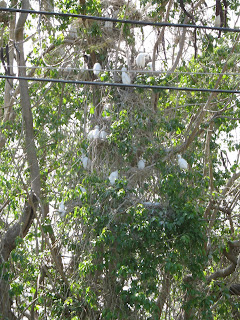
A tree full of baby egrets

We followed a road down and along below a small inn with a swimming pool, where children were having a great and boisterous time. Then we followed a little rise and, behold! Three levels of thermal bath, the topmost and hottest featuring water at 110F. We went hunting for a place to change and finally tucked ourselves into some bushes above and back from the baths. Later we would learn that there was a changing room, disguised as a shed connected to a locked cement structure.

WW in the middle bath

Your blogger in the hottest bath...feeling faintly lobsterish

The bathing was lovely. Recommendations say no more than 15 minutes, then a breather. It’s not as though you have much choice; we’re talking hot water. Various people, young and old, were making use of the baths. One elderly fellow seemed to be giving himself a cure. He hobbled from one end to the other of the deepest pool, making determined circuits and looking pained. We chatted with a few of the people, then, after soaking up all those tiny ppms of hydrochloric acid and sulphuric acid and carbonic acid (it’s a wonder we had any skin left), we headed back to Ponce, our laundry, and Django.

That evening, WW decided we should go to an upscale restaurant for dinner. He wanted a steak. So we settled on Rincón Argentino. I had read that parking would be tough in the old town, so we parked on the extreme outskirts. After walking many blocks in the dying daylight and seeing miles of parking spots, we returned to the car. The blocks we had walked were not ones we would happily do late at night. We parked a block from the restaurant.

The steaks were amazing. WW ordered rib steak and I ordered a small filet, for about $22 US, including two side dishes. My steak was just about a perfect 3-inch square, done to rare perfection. The one thing it wasn’t was small. There was live music performed by a man singing at a bandoneon (kinda like an accordion), who later accompanied himself on guitar; he was also very good. He played some Piazzolla, one of WW’s favourite composers. A perfect end to a sulphurous day.
Ponce


The next day, we headed off to Ponce (pronounced PON-say), named for the Spanish explorer and conquistador Ponce de Leon. There are a lot of lions in Ponce…statues, banners, decorative details. The ponceños are inordinately proud of their city, which they call La Perla del Sur (the pearl of the south).

Our passage there was uneventful. WW and I stood on deck and watched the sea. Flying fish are always good for a laugh. I can’t help chuckling whenever I seem them panic through the air. Outside Ponce, at one of the cans marking the shipping channel, a group of large porpoises came to check us out. We weren’t big enough, I think; they wanted real ships.

We made our way into the Ponce Yacht and Fishing Club basin where we fuelled up, bought ice, and WW went to sign us in. Our reservation was for the next day, but the space was available. We were delighted to see Unchained, Gabridash, and Marie-Galante 2 had all arrived safely and were docked here too.

We had arrived at a place where water was free…a pleasant change from $0.50 or more per gallon. I scrubbed the deck and did some laundry. Richard dropped by and invited us to Marie-Galante for drinks that evening. I said I’d bring the fixings for RP. We snoozed and pottered until then.

On Marie-Galante, we learned it was Lucie’s birthday. We toasted her with RPs that were very well received. Then Richard pulled out the Bacardi 151 he’d picked up on their visit to the factory. Yep, that’s 151 proof. It requires water. It requires lying down and avoiding. We were pretty chipper by the time we left them to their fondue birthday dinner.

We made an early night of it, which was just as well, since we awoke to discover that, while we were sleeping, Django was breaking. The fridge had expired. I threw away lots of food while WW pondered. Then he dove headfirst into the Disaster Hole…that’s the doorless locker to starboard just inside the hatchway to the salon. Here we throw flares, bosun’s chair, rum, shoes, life jackets, come-along, binoculars…the bric-a-brac of boating life. Behind its back panel lay access to…the fridge.

WW got things loosened up and wires figured out. I supported the fridge while he used his little multimeter to test things. It took a while, so I balanced a book on top of the fridge and read while he metered and muttered. When so instructed, I helped him reinsert the fridge. Eureka! A miracle cure…and one for which WW had spent almost no time head down!

Once WW fixes something, he’s on a roll. He goes on to deal with other minor annoyances. He made the solar fan in our berth work properly…by opening it. He also found the manual for the fans and learned the batteries can be replaced. So industrious.

Into the Caribbean Sea


Because the wind grows steadily stronger over the course of the day, we try to get our sailing/motoring into it done early. On Tuesday, April 15, we set off at 6:30 a.m. for an anchorage that was to be one of the finest both in terms of bottom (made WW so happy) and what we found there. We also, finally, entered the Caribbean Sea.

The bay at Gilligan’s Island (don’t ask me) is a regular stop for cruisers travelling along the south coast of Puerto Rico. The island itself is a red hot weekend spot for puertorriqueños. The whole area is surrounded by mangroves which keep the water green and fertile and are, as we are informed repeatedly, the nurseries of the sea. They are also flat-out, no question about it, totally impenetrable to persons without implements of hackage and hewage.

It’s all part of the Bosque Estatal de Guánica or Guánica Biosphere Reserve: 9,500 acres of preserved land with 36 miles of trails and 10 miles of undeveloped coastline. Most important, a significant chunk is subtropical dry forest. Just 1% of the world’s dry forests remain, making this an exceptional bit of land. The central cordillera captures all the moisture, putting this region in a serious rain shadow. Temperatures remain between 80F and 100F all year, and about 35 inches of rain per year (which WW thinks is a guidebook error…seems too much to him)—compare that to Puerto Rico’s El Yunque rain forest, which gets one inch a day. The park is a haven for 700 plant varieties, 40 bird species, toads, crabs, turtles, and more. Sadly, mongooses, introduced to control rats, have found turtle eggs much to their liking and the turtle population is in severe decline.

We launched Boffo and followed a mangrove-lined channel between one of the islands and the mainland until we reached a beach near the sea. WW scanned the mangrove roots hopefully (and in vain) for oysters, while I scanned the birds…great egrets, black-necked stilts, magnificent frigate birds, black vultures, bridled terns, and the charming brown pelicans.


Stilts among the mangroves of Bosque Estatal de Guánica

We followed a path that took us from the sodden mangrove swamp, past brackish pools, to dry coastal growth of tough grasses, coconut palms, and a variety of plants and shrubs clearly adapted to receiving little water. In one of the ponds, a gaggle of stilts muttered imprecations as I photographed them. Kingbirds nagged each other. The clear liquid notes of yellow warblers trailed after them as they flashed like gold between shrubs. Then we arrived at the dry forest. The mangroves and low coastal growth gave way almost instantly to thorn trees and cacti. Bright orange land crabs scuttled into their burrows as we passed. Alas, it was getting late and we had to turn back if we were to make it to the boat before sundown. It is a fascinating place I most definitely want to visit again.

We didn’t go straight back to the boat. Instead, we set foot briefly on Gilligan’s Island. Why? Silly not to.


Anchors Aweigh!

As a preamble, let me apologise for having been somewhat remiss in keeping this blog up to date. Once I have caught up (hah!), perhaps you will find it in your hearts to forgive me…assuming anyone is still reading.

When last we met, WW and I were in Boquerón. At about 8:30 a.m. on Monday, April 14, we raised anchors. Yes, plural. When raising anchor, my job is to stand at the bow, manage the winch, and gesticulate wildly so WW knows which way to aim the boat. I felt the winch was behaving oddly. Perhaps it, like me, is not a morning person. Metre after metre of chain rolled slowly into the (warning: technical term) chain locker, a.k.a. the place where the anchor chain goes when it’s not out. Then the reason for the winch’s sluggishness was revealed. Our anchor chain had become well and truly fouled in another, much larger anchor. Ours is about 40 lbs, this one WW guesstimates was about 75 lbs. With a lot of boat hook action, muscle strain, a good deal of grunting, and (of course) hanging head down, WW managed to free the anchor and it’s resident crab. Both plunged back to the seabed to await the next unwary anchor chain.

Once the anchor was aboard, I completed my post-anchor-raising task, that of binding Tramp firmly to the tramp. In some of the seas we’ve been seeing, she’d be a gone kayak if she weren’t tied down hard. And Lady would get lonely. While I was busy tying multiple little tight knots, WW was steering us through the small opening in the reef and out to the open seas.

We cruised down the coast towards Cabo Rojo, which is unjustifiably confusing, since it is the name of both the cape and the region. To add to the confusion, the cape is also called Punta Jagüey. It was only a few hours run, and we tucked ourselves into Bahía Salinas, on the west side of the punta/cabo. This took considerable tucking since the bottom was bad and our hook wouldn’t hook. On the bay’s edge lay a wrecked yacht, just to keep us on our toes. It took us about half a dozen tries before WW was satisfied that we might not drift into the rocky shore. Still, he was out of the berth about six times that night, making sure we were where we thought we were.

Lighthouse at Cabo Rojo

Once we had a chance to look around, we found ourselves with a wonderful view of the Faro de Cabo Rojo, a lighthouse built in 1881, warning ships as they enter and leave the Mona Passage.

Although we had now been on two Caribbean islands, we still weren’t in the Caribbean. It lay just around the corner.