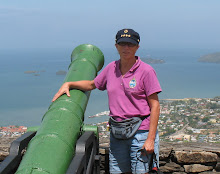
We did the crossing to Dominica the next day. It was a pretty wild run. The wind was blowing 20 knots with gusts to 30. We howled down the distance and were very happy to finally tuck ourselves into a mooring at Portsmouth, on the northeast of the island.
WW had visited here last year with Alicia and her admirers queued up to welcome them back. Alas, I appeared, not Alicia. She is, clearly, missed.
On Friday, a wonderful man named Fire took us in his magnificent boat up the Indian River. All the guides and water rats have boats painted in the most wonderful colours. Fire's also features quotes from Jamaican (Rasta) music he particularly likes. We motored across Prince Rupert's Bay to the river's mouth, on the way marvelling at the number of massive wrecks strewing the waterfront. They are all the products of hurricanes. In one place, there was a wreck on top of a wreck. A project is under way to cut them up. The resulting hunks of metal and wood are loaded onto barges and taken out to sea. For now, though, waterfront property in Portsmouth is as likely to have a view of a rusting quarterdeck as of the Caribbean.
At the entrance to Indian River, Fire killed his engine, and put his oars between tholes and started to row/pole us up the gently river. It is illegal to use motors on the river, to the tune of a $5,000 EC fine. Fire pointed out different plants, crabs he says are good eating, herons and smaller birds. He took us up a branch of the river which became very dark in the shadow of the huge gum trees. At length, we arrived at a little bar in the woods where I had delicious ginger tea and WW had a coffee. Then we followed a path into the forest that led at last to an enormous gum tree, with huge buttress roots that overtopped us.
As we returned down the river, Fire told us about the coming election. He, and most of Portsmouth, seem very keen on the incumbent. Each night we were treated to loud music blaring from massive speakers mounted on trucks, and to different voices exhorting. Words like "respect", "corruption", "dignity", "responsibility" echoing across the bay. The Friday night electioneering (Friday is the traditional Portsmouth party night) went on until about 4 a.m. We know, we heard it all.
That evening we ate freshwater "crawfish" (prawns) at the Purple Turtle. WW insists they are frozen imports. Everyone we talked to says they catch and eat them. I suspect WW is right, but they were delicious anyhow.
Thursday, December 17, 2009

Bourg and Terre-de-Haut
Guadeloupe features a number of offshore islands: Les Saintes, Marie-Galante, Desiderade. Les Saintes is a cluster of small islands, two of which are inhabited. We were at the larger of these, Terre-de-Haut, anchored in the Baie des Saintes off its booming metropolis Le Bourg.
After rocking and rolling (well, not true, catamarans don't really roll) around all night, we headed ashore for a little leg stretching. We decided to head up the hill to Fort Napoleon. This turned out to be a very pleasant walk of about 20 minutes. The only real danger is the flotilla of tourists who rent scooters and zip incompetently about. The island is so tiny, one wonders at their endangering life and limb (theirs and those of others) rather than indulging in the extremely pleasant rambles available which let you see birds and plants and lizards and all manner of tropical whatsits.
Fort Napoleon is atop a hill overlooking Bourg. It is either well restored or on the way there. There is a nice walk around the ramparts, with splendid views and an extensive collection of cactus.
The central area of the fort proper contains a large barracks (I believe) which is home a rather good museum. One room features a great deal of detail about the April 12, 1782, Battle of Les Saintes when British Admiral Sir George Rodney, with a fleet of 18 (?) sail took on and defeated a French fleet of 34 (?) on its way to conquer Jamaica. (Not sure of the numbers, but there was a heavy imbalance favouring the French. The English fleet split the French line in two...not normal tactics at all, in fact, for the first time in fleet action...and were able to sink or capture most of the enemy fleet.) The museum displays had lots of little model boats lined up to illustrate this rather catastrophic defeat. Les Saintes was returned to France by treaty later on.
I'm not sure where I picked up this tidbit...might have been at Fort Napoleon: with the sugar trade being so fantastically lucrative, back in the day, one treaty proposition from the period was for England to trade all of Canada to the French in exchange for Guadeloupe!
We had sandwiches for lunch in Bourg, then spent the afternoon aboard Django, reading, lolling, snoozing. We dined ashore and here I was introduced to the appalling beverage of which, for some reason, Guadeloupe is so proud: ti-punch. Lime juice (not enough), sugar or sugar syrup (too much) and the vile liquid the French call rhum agricole (before-, during- and afterburn). No ice. But the meal was very nice.
In terms of ice, we found Bourg to be an ice-free zone. Mind you, we started out asking for "glace" and were sent back and forth through the entire village a couple of times before realizing we were being sent to ice cream shops. We then resorted to "glacons". No joy.
On Wednesday, we walked over to Pompierre Beach in the company of a number of cruise ship people. It is a really lovely walk, through farmland, to a beautiful beach enclosed in a lagoon. On our way back, we stopped at a little restaurant for delicious accras (salt cod and okra fritters) and a very good tuna sandwich.
Then it was back to Django for another quiet afternoon of swimming, sunbathing, reading, snoozing. Peas and rice for dinner.
After rocking and rolling (well, not true, catamarans don't really roll) around all night, we headed ashore for a little leg stretching. We decided to head up the hill to Fort Napoleon. This turned out to be a very pleasant walk of about 20 minutes. The only real danger is the flotilla of tourists who rent scooters and zip incompetently about. The island is so tiny, one wonders at their endangering life and limb (theirs and those of others) rather than indulging in the extremely pleasant rambles available which let you see birds and plants and lizards and all manner of tropical whatsits.
Fort Napoleon is atop a hill overlooking Bourg. It is either well restored or on the way there. There is a nice walk around the ramparts, with splendid views and an extensive collection of cactus.
The central area of the fort proper contains a large barracks (I believe) which is home a rather good museum. One room features a great deal of detail about the April 12, 1782, Battle of Les Saintes when British Admiral Sir George Rodney, with a fleet of 18 (?) sail took on and defeated a French fleet of 34 (?) on its way to conquer Jamaica. (Not sure of the numbers, but there was a heavy imbalance favouring the French. The English fleet split the French line in two...not normal tactics at all, in fact, for the first time in fleet action...and were able to sink or capture most of the enemy fleet.) The museum displays had lots of little model boats lined up to illustrate this rather catastrophic defeat. Les Saintes was returned to France by treaty later on.
I'm not sure where I picked up this tidbit...might have been at Fort Napoleon: with the sugar trade being so fantastically lucrative, back in the day, one treaty proposition from the period was for England to trade all of Canada to the French in exchange for Guadeloupe!
We had sandwiches for lunch in Bourg, then spent the afternoon aboard Django, reading, lolling, snoozing. We dined ashore and here I was introduced to the appalling beverage of which, for some reason, Guadeloupe is so proud: ti-punch. Lime juice (not enough), sugar or sugar syrup (too much) and the vile liquid the French call rhum agricole (before-, during- and afterburn). No ice. But the meal was very nice.
In terms of ice, we found Bourg to be an ice-free zone. Mind you, we started out asking for "glace" and were sent back and forth through the entire village a couple of times before realizing we were being sent to ice cream shops. We then resorted to "glacons". No joy.
On Wednesday, we walked over to Pompierre Beach in the company of a number of cruise ship people. It is a really lovely walk, through farmland, to a beautiful beach enclosed in a lagoon. On our way back, we stopped at a little restaurant for delicious accras (salt cod and okra fritters) and a very good tuna sandwich.
Then it was back to Django for another quiet afternoon of swimming, sunbathing, reading, snoozing. Peas and rice for dinner.
Wednesday, December 16, 2009
A coast to Les Saintes
After our visit we walked back to town, half hoping to find the woman we’d met the day before sitting beside the road with two huge, hand-cranked ice cream makers. One had been full of coconut sorbet, the other of soursop sorbet. Both were wonderful. Like so many others, she was observing her day of rest, so we returned sorbetless to the Django.
We had a spot of lunch, then weighed anchor to proceed south down the coast to Pigeon Island.
Jacques Cousteau famously declared the waters around this tiny island to be some of the best diving in the world. It is, in consequence, much visited by divers and snorkellers, a number of tour and sightseeing operations make a living from this notoriety, so it can be quite busy during daylight hours, though the little island itself is uninhabited...except by pigeons. The area has been designated a national park.
We picked up a mooring off the island and did what you’re supposed to do here. We snorkelled. Lovely it was. Lots of fish. But the coral is almost all gone. Coral reefs are in desperate shape with bleaching. We see it more and more. This year is reported to have been not bad since the waters didn't get too warm.
A beef curry for dinner, cooked up with green bananas, potatoes and yoghurt was very tasty.
Thus we celebrated the birthday of Django’s bold captain.
The following day, we worked on Django’s trampoline, which needed to be tightened and to have its rods lashed in (they tend to slip out of the loops holding them). We then raised anchor and headed down to Les Saintes, a cluster of beautiful little islands south (and part) of Guadeloupe.After clearing the southern tip of the island, the waves became much larger and the wind much stronger. We sailed down to Bourg les Saintes, on the island of Terre Haute, in about 25 kts with gusts to 30 kts.
The anchorage had a pretty strong surge to keep things active, but we’ve had worse. We downed our RPs and dinner, planned our explorations for the next day and, as usual, were early to bed.
We had a spot of lunch, then weighed anchor to proceed south down the coast to Pigeon Island.
Jacques Cousteau famously declared the waters around this tiny island to be some of the best diving in the world. It is, in consequence, much visited by divers and snorkellers, a number of tour and sightseeing operations make a living from this notoriety, so it can be quite busy during daylight hours, though the little island itself is uninhabited...except by pigeons. The area has been designated a national park.
We picked up a mooring off the island and did what you’re supposed to do here. We snorkelled. Lovely it was. Lots of fish. But the coral is almost all gone. Coral reefs are in desperate shape with bleaching. We see it more and more. This year is reported to have been not bad since the waters didn't get too warm.
A beef curry for dinner, cooked up with green bananas, potatoes and yoghurt was very tasty.
Thus we celebrated the birthday of Django’s bold captain.
The following day, we worked on Django’s trampoline, which needed to be tightened and to have its rods lashed in (they tend to slip out of the loops holding them). We then raised anchor and headed down to Les Saintes, a cluster of beautiful little islands south (and part) of Guadeloupe.After clearing the southern tip of the island, the waves became much larger and the wind much stronger. We sailed down to Bourg les Saintes, on the island of Terre Haute, in about 25 kts with gusts to 30 kts.
The anchorage had a pretty strong surge to keep things active, but we’ve had worse. We downed our RPs and dinner, planned our explorations for the next day and, as usual, were early to bed.
Garden party
It was now Sunday (also WW’s birthday) and very little would be open. A signal exception was the Jardin Botanique de Deshaies, a mile or so south of town. We set off bright and early and had a very pleasant walk there.
In the parking lot, we found the Caribbean version of the warning sign “Falling rocks”. The island version translates loosely as “Falling mangoes”.
The gardens were gorgeous and beautifully maintained, with paved pathways and clear signs for the plants, trees, and flowers. They included a couple of aviaries with lorikeets, flamingoes and macaws, lots of orchids bursting with blossoms, fruit trees, a banyan, and much more. The best way to tell you about it is to show it to you.
 Feeding the koi in the huge pond at the entrance to the Jardins Botaniques
 One of many orchids in bloom.
Except the connection here. (We're back in English Harbour, Antigua, is too slow. There are dozens of boats anchored or at the pier here, all battling for their little piece of bandwidth. I've got a couple on. More when I get home.)
In the parking lot, we found the Caribbean version of the warning sign “Falling rocks”. The island version translates loosely as “Falling mangoes”.
The gardens were gorgeous and beautifully maintained, with paved pathways and clear signs for the plants, trees, and flowers. They included a couple of aviaries with lorikeets, flamingoes and macaws, lots of orchids bursting with blossoms, fruit trees, a banyan, and much more. The best way to tell you about it is to show it to you.
 Feeding the koi in the huge pond at the entrance to the Jardins Botaniques
 One of many orchids in bloom.
Friday, December 11, 2009
Where we are now
I think I should just report that my blog is rather behind on our actual spot on the world. I have been writing about Deshaies, which was more than a week ago. Since then we have:
- been to Pigeon Island and thence to Les Saintes;
- been to Portsmouth, Dominica;
- been to Roseau, Dominica, and had a thief aboard in the night (3 a.m., he arrived by surfboard);
- speaking for myself and despite crime, no matter how incompetent, fallen in love with Dominica;
- gone from Roseau back up to Portsmouth and then had a magnificent sail up to Point a Pitre in Guadeloupe.
We are here now, we are well, happy and hungry. Dinner beckons. Check in with you all later.
- been to Pigeon Island and thence to Les Saintes;
- been to Portsmouth, Dominica;
- been to Roseau, Dominica, and had a thief aboard in the night (3 a.m., he arrived by surfboard);
- speaking for myself and despite crime, no matter how incompetent, fallen in love with Dominica;
- gone from Roseau back up to Portsmouth and then had a magnificent sail up to Point a Pitre in Guadeloupe.
We are here now, we are well, happy and hungry. Dinner beckons. Check in with you all later.
Around Deshaies
After clearing in, we decided to explore. Our friends Madeleine and Jerome have spent many happy winter vacations on Guadeloupe and had given us a pencilled scrawl to guide us to important spots. The Musee de Rhum looked promising and proximate. We asked a taxi driver; he wanted 60 Euros to take us there. The bus was 2 Euros each. Guess which we took?
The buses in Guadeloupe (and, presumably, Martinique) are unlike buses in other Caribbean countries we have visited. These run on something resembling a schedule, are actual small buses rather than minivans, do not have loud music playing constantly, stop at designated stops. Oh, and the roads are paved, rather than having extended areas of potholes and road-wide devastation, not to mention and absence of sleeping policemen. The buses positively pelt along. It’s all terribly...European. Our driver (together with most of the passengers) was much interested in delivering us to the correct place for our transfer to the bus that would carry us on to our destination. There was clearly a suspicion that, as tourists, we might not make it. We were successfully deposited in Ste. Rose where we, equally successfully, caught the bus to our next destination. We tried to get off at the wrong stop. The crowd was outraged. At last, we were gently deposited at the end of a long, not very steep road up a hill. We climbed.
The Musee de Rhum was, in all honesty, not much different from the one we’d visited in Grenada. There were, however, a few significant differences. This one has an outstanding collection, from sugar-producing nations around the world, of the machetes or scimitars (as some islands call them) used in harvesting sugar cane (the basic ingredient of rum). It also has an absolutely amazing collection of mounted Caribbean and, more specifically, Guadeloupan insects. Truly stunning. Finally, it has a room full of beautifully displayed wooden model ships representing boats as old as the Phoenecian and as recent as the Titanic. Well worth the visit.
We walked back to Ste. Rose and had a pretty nasty sandwich there, then made our way into the centre of town where we bought a few provisions, found the bus to Deshaies, and headed back to our wee boat.
A quiet afternoon and evening ensued.
Thursday, December 10, 2009
South to France
Django is less orange than heretofore. Her forward cross beam was painted blue, her boot top (the line around her hulls at water level) was painted blue, her hulls have received a coat of blue antifouling paint. The only major bit of orange remaining is her bimini and it is not long for this world. Every seam looks like a dotted line just waiting to be torn along. We may be getting her a new bimini over Christmas and we’ve decided an undyed canvas (oatmeal or tan) would be nice. WW likes dark blue, dark green and red...all very hot in the tropics.
Upon arrival in English Harbour, flushed with the success of his engine repairs and his brilliant choice and installation of propellers, WW was grinning like a schoolboy. Of course, true to the cruiser’s rubric—while you are sleeping, your boat is breaking—he discovered the vang’s hydraulics had gone kaflooey. The vang originates at the base of the mast and attaches a short distance along the boom. While sailing, it holds the boom down; while at rest, it holds the boom up. Happily, it was the at rest bit that had gone. We moved the topping lift and our colours from the port stern pulpit to the end of the boom. Voila, boom up and who needs vang hydraulics?
Bright an early on Thursday, November 26, we were under way for Guadeloupe. We were able to do a bit of sailing but, for the most part, it was an upwind bash. Fortunately, there wasn’t much wind. We arrived in the evening, too late to clear in, so had our RPs followed by pork medallions sate (very good).
Our port of entry was Deshaies (pronounced Day-yay) in the northwest of the western part of the island. Guadeloupe is shaped like a malformed butterfly. The western part is Basse Terre and the eastern part is Grande Terre. Basse Terre is, of course, mountainous; Grande Terre is, of course, smaller than Basse Terre. Go figure. The two halves are joined by an isthmus that has la Riviere Sale running through the middle of it (I guess that means that they aren't attached after all).
We headed into Deshaies in the morning to clear in. To enter the town by dingy, you must go up a small and lovely river to a docking area.

Coming in to the Deshaies dinghy dock (around the corner and out of sight).
We climbed a long hill to the customs house where a sign (I love French red tape...they don't really believe in it) told us to go to the Pelican Cyber Cafe and clear in there. So down the hill we went, walked along the main drag and, within two minutes, were in the Pelican, at the computer terminal, clearing in.
Subscribe to:
Posts (Atom)